AI case study generator
Your customer already told the story. Now it's a case study.
Pick a testimonial and a story shape. Proof Intelligence writes the case study, a headline, a summary and 3 to 6 sections, from what your customer said. Their quotes stay word for word, and any number it can't find in the testimonial is marked for you to check.
On Premium and Business · 2 credits a case study · it shows the price and asks before it spends
The Outcome-led case study
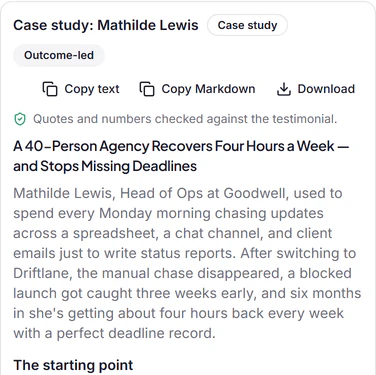
A 40-Person Agency Recovers Four Hours a Week — and Stops Missing Deadlines
Mathilde Lewis, Head of Ops at Goodwell, used to spend every Monday morning chasing updates across a spreadsheet, a chat channel, and client emails just to write status reports. After switching to Driftlane, the manual chase disappeared, a blocked launch got caught three weeks early, and six months in she's getting about four hours back every week with a perfect deadline record.
The starting point
Goodwell is a forty-person agency, and before Driftlane their projects lived in three places: a spreadsheet for the timeline, a chat channel for status, and whatever the client emailed. Every Monday, Mathilde spent the morning chasing people for updates so she could write the client reports. They'd tried two other tools before, and both died within a month because nobody kept them up to date.
What changed
Driftlane was different from the first afternoon. The team imported eleven active projects, and instead of dropping fields it couldn't map, it flagged them. The weekly digest took over the status-chasing entirely — it goes out on its own, and clients actually read it. In March, the dependency view showed a design review blocking a launch three weeks out, and the team moved it before anyone noticed.
The result
Six months in, Mathilde gets about four hours back every week, and the team hasn't missed a client deadline since they switched.
If your team's status updates are scattered across spreadsheets, chat, and email, it's worth a closer look at how Driftlane handles reporting and dependencies.
Closing lineNames no offer, demo or discount. You add yours.
Real case studies, written by Proof Intelligence from a testimonial about Driftlane, our made-up demo product. Not edited. The face is a stock photo.
A good testimonial is an interview you never had to schedule.
A case study needs what it was like before, what changed and the result. Your best testimonials already say it, in your customer's own words. These are where they come from.
Video testimonials
A video's transcript is read, so two minutes of a customer talking become the raw material.
Collect video testimonialsDetailed reviews
A long review you import from G2, Capterra or Google is read like any testimonial.
Import your reviewsForms that ask
Ask what it was like before, what changed and the result. The case study reads every written answer, not only the first.
Build a form
Two sentences make a quote, not a case study.
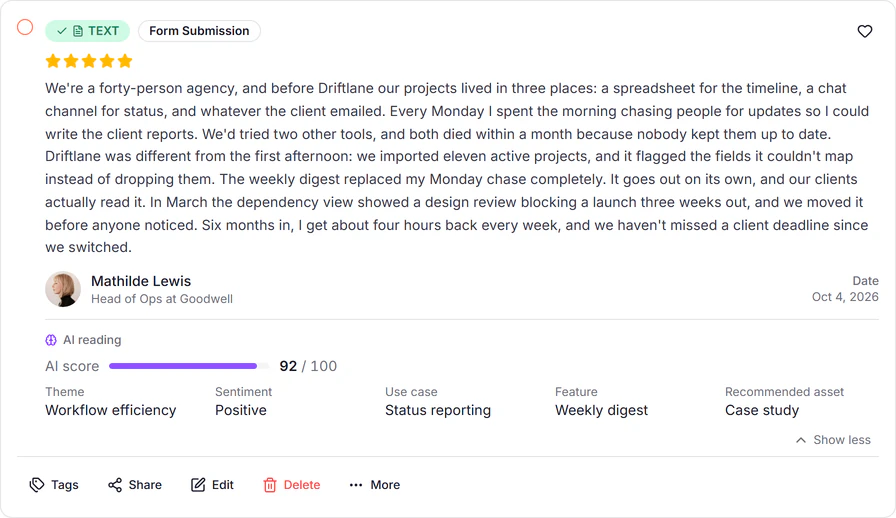
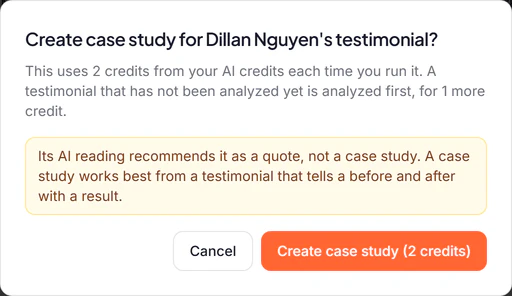
Every testimonial's AI reading names the asset it would make best. Mathilde's story says Case study. Dillan's two sentences say Quote, and the question before you spend credits on a case study from them says so. Filter your inbox by Recommended asset → Case study to find the testimonials with a story.
Four ways to tell the same story.
A template sets the section headings and the tone. Outcome-led is where it starts. A heading the testimonial can't support is reworded or left out, never filled in.
Default
Outcome-led
Numbers up front. The story explains why. Best for landing pages and decks.
- The starting point
- What changed
- The result
Tone: Punchy, deck-ready, light on metaphor
Use it for: Pricing pages, Conversion lift, Sales decks
See Mathilde's, in Outcome-ledSwitching
Migration narrative
Frames the story around moving from a competitor or legacy process.
- Before — the old way
- Why we moved
- How migration went
- Where we are now
Tone: Empathetic, comparative, honest about friction
Use it for: Comparison pages, Sales objections, Onboarding
See Mathilde's, in Migration narrativeLong-form
Practitioner journey
Reads like a personal essay. The customer is the protagonist; product is the tool.
- The job
- The hunt
- The pivot
- The setup
- The win
- What's next
Tone: First-person flavored, narrative, warm
Use it for: Customer blog, Newsletter, Community
See Mathilde's, in Practitioner journeyVertical / persona
Use-case spotlight
Anchors the study in a single use case or persona slice. Great for ICP plays.
- The use case
- The team
- The setup
- The metric
Tone: Persona-aware, jargon-tuned, specific
Use it for: ICP campaigns, Industry pages, ABM
See Mathilde's, in Use-case spotlight
Each click of Create case study writes a new case study and keeps the ones before it, so trying all 4 templates on one testimonial costs 8 credits.
It won't put words in your customer's mouth.
The AI is told to write only from what your customer said. Then the code checks what it wrote, before the case study is saved.
Quotes are copied, never tidied.
A passage in quotation marks is kept only in your customer's exact words. One that isn't loses its quotation marks. The 3 quotes in Jackson's case study were found, word for word, in Jackson's review:
nobody could see who was overloaded
put it off for most of
assumed we would lose our history
Every number is looked for.
In figures or in words. One it can't find is listed above the case study, after Not in the testimonial, and stays as written for you to check.
| In the case study | In Mathilde's words |
|---|---|
| 40 | “forty-person agency” |
| Four | “about four hours back” |
| three | “three weeks out” |
| six | “Six months in” |
| three | “three places” |
| two | “two other tools” |
| eleven | “eleven active projects” |
The closing line makes no offer.
It invites readers like your customer to look closer, and names no demo, trial, discount, price or link. You add yours. Mathilde's:
If your team's status updates are scattered across spreadsheets, chat, and email, it's worth a closer look at how Driftlane handles reporting and dependencies.
It's still a draft written by AI, about a real customer. Read it, and send it to them, before you publish.
Your next case study is a testimonial you already have.
Start free — no cardFrom your inbox to your page.
Find the story.
On Approved, filter by Recommended asset → Case study, or search in your own words. Then open a testimonial's AI menu and choose View AI insights.
AI search & filtersPick a shape. See the price.
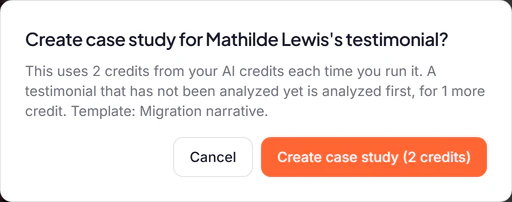
Choose a template, then Create case study. A question names the template and the 2 credits, and nothing is spent until you answer it. If writing fails, the credits come back.
Copy it out.
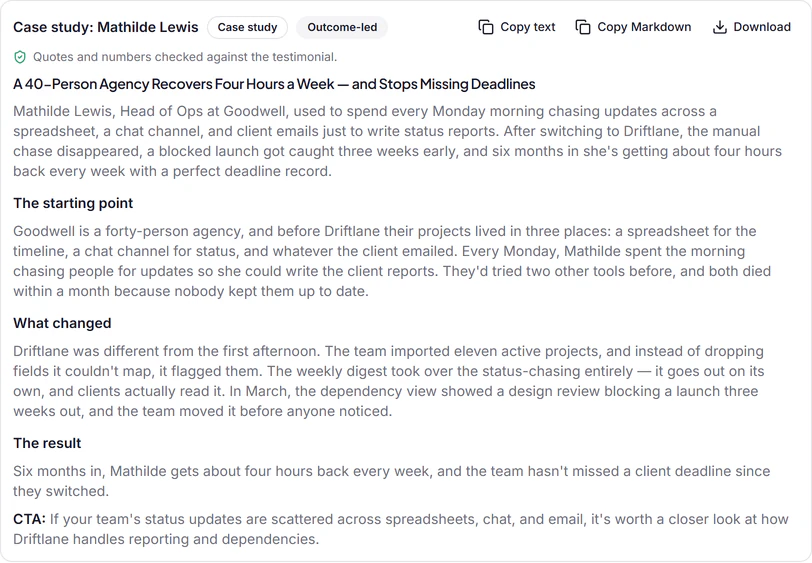
It's added to Generated Documents, with what the checks found above it. Copy text pastes headings and paragraphs into Google Docs, Notion, Word or an email; Copy Markdown and Download give you Markdown.
And something shorter, for everywhere else.
Emphasize text, beside the case study button, writes short lines from the same testimonial for 1 credit. The short quote is always your customer's own words. These are Mathilde's.
One-liner
Four hours back every week, and zero missed client deadlines since switching to Driftlane.
Short quote
Six months in, I get about four hours back every week, and we haven't missed a client deadline since we switched.
Social caption
Mathilde Lewis, Head of Ops at a 40-person agency, used to spend every Monday morning chasing updates for client reports. With Driftlane's weekly digest, that's gone. Six months in: four hours back every week, and no missed client deadlines since switching.
Highlights
- "The weekly digest replaced my Monday chase completely. It goes out on its own, and our clients actually read it."
- Dependency view flagged a design review blocking a launch three weeks out, giving time to fix it before anyone noticed.
- Imported eleven active projects, with unmapped fields flagged instead of dropped.
Both start from the testimonial's AI reading: AI sentiment analysis. Put the short quote on your site with the widget builder.
2 credits a case study. Shown before you spend.
On Premium and Business. A testimonial that hasn't been analyzed yet is analyzed first, for 1 credit more, and a case study that fails to write gives its credits back.
- Premium
- 50 credits a month for each active project: up to 25 case studies if they go to nothing else.
- Business
- 150 credits a month for each active project: up to 75 case studies if they go to nothing else.
- Credit packs
- 100 for $9.99, 500 for $39.99, 1,000 for $69.99: 14 to 20 cents a case study.
- Who
- The owner, Admins and Members write case studies. Viewers can read them.
What it doesn't do
- Interview your customer, or ask them to approve. Send it to them yourself.
- Publish or host the case study, or make a PDF. Copy it into your site, doc or deck.
- Know your brand voice or your offer. The template sets the shape and tone; you add the offer.
- Write one case study from several testimonials. It's one testimonial, one story.
- Change the testimonial. The case study sits beside it, in its Proof Intelligence window.
Questions
The details are in the guide: Create a case study from a testimonial.
Which plans include the case study generator?
Premium and Business. Premium includes 50 AI credits a month and Business includes 150 AI credits a month for each active project, shared with the other AI actions. Packs of extra credits are there when you need more.
What does a case study cost?
2 credits, shown on the button and asked before anything is spent. A testimonial that hasn't been analyzed yet is analyzed first, for 1 credit more. If writing fails, the 2 credits come back. From a credit pack, that's 14 to 20 cents a case study.
Will it make things up?
It's told to write only from what your customer said, to keep their hedges ("about four hours") and to add no context they didn't give. Then the code checks what it wrote: a passage in quotation marks is kept only in your customer's exact words, and every number is looked for in the testimonial. A number it can't find is listed above the case study for you to check. It's still a draft written by AI, so read it before you publish.
What makes a good testimonial for a case study?
One that tells a story: what it was like before, what changed and the result, ideally with numbers. Video testimonials (the transcript is read), detailed reviews and answers to a form that asks those questions work best. Two sentences make a good quote and a thin case study, and the question before you spend says so when the testimonial's AI reading recommends something else. Filter your inbox by Recommended asset → Case study to find the ones with a story.
Can I choose how the story is told?
Yes: 4 templates, Outcome-led, Migration narrative, Practitioner journey, Use-case spotlight. Each sets the section headings and the tone; Outcome-led is the default. A heading the testimonial can't support is reworded or left out rather than filled in.
Does it read a form's other answers?
Yes. When a testimonial came from a form that asked several written questions, the case study reads every written answer, not only the one that became the testimonial's text. Private feedback is never read.
How do I get it into my site, deck or doc?
Each case study has Copy text (headings and paragraphs, ready for Google Docs, Notion, Word or an email), Copy Markdown and Download (a Markdown file). ReTestimonial doesn't publish or host case studies, and doesn't make PDFs.
Can I edit a case study, or try another version?
Edit it wherever you paste it. Each click of Create case study writes a new one and keeps the earlier ones, so trying every template on one testimonial costs 8 credits.
Where are case studies kept?
In the testimonial's Proof Intelligence window, under Generated Documents, newest first. They never appear on your widgets, Wall of Love pages or share pages, and they never change the testimonial. Deleting the testimonial deletes them.
Who on my team can write one?
The owner, Admins and Members can. Viewers can read them but not write them.
Does it ask my customer to approve the case study?
No. Send it to them yourself before you publish: it's their story, with their name on it.
The best case study you'll publish this month is already in your inbox.
Written from your customer's own words, on Premium and Business.